
How to Reset Your Nervous System When You Feel Overwhelmed
5 simple techniques to help your body come out of fight-or-flight quickly and regain calm

Sometimes overwhelm arrives all at once.
Your thoughts speed up. Your chest tightens. Even small problems start to feel unmanageable.
Most people respond by trying to think their way through it. But overwhelm isn’t just a mental problem — it’s a nervous system response. When your body shifts into stress mode, your breathing changes, your muscles tense, and your brain becomes focused on threat instead of clarity.
Until your body settles, your mind usually can’t.
The techniques below work by giving your nervous system simple signals that the pressure has passed. A slower breath, rhythmic tapping, grounding your senses, or activating the vagus nerve can interrupt the stress response and help your body reset.
When that happens, something subtle shifts.
Your breathing deepens.
Your shoulders drop.
Your thoughts begin to slow.
And the moment that felt overwhelming becomes something you can actually handle.
Disclosure: This article is for informational purposes only. If you make a purchase through the links provided, I may earn a small commission at no additional cost to you. As an Amazon Associate, I earn from qualifying purchases.
1. The 4-7-8 Breathing Technique
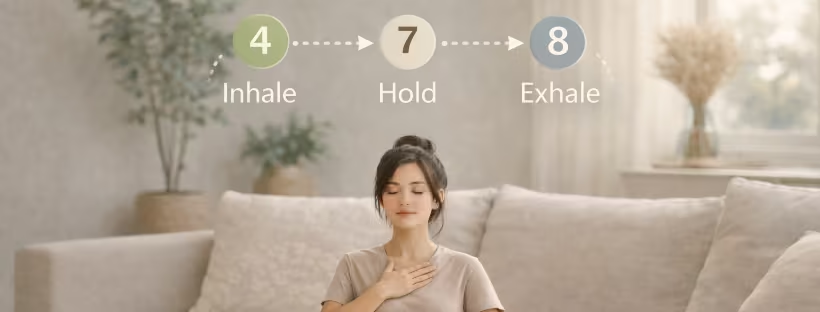
When your nervous system shifts into a sympathetic (fight-or-flight) state, your breathing becomes faster and more shallow. This pattern reinforces activation—your body interprets it as a signal to stay alert.
Changing the breathing pattern is one of the fastest ways to influence that state directly.
Inhale through your nose for 4 seconds.
Hold the breath for 7 seconds.
Exhale slowly through your mouth for 8 seconds.
Repeat this for 3–5 cycles.
The extended exhale is the critical part. Longer exhales increase parasympathetic activity, which slows heart rate and reduces nervous system activation.
The breath hold also creates a brief rise in carbon dioxide, which can help reset breathing patterns and reduce the tendency toward rapid, shallow breaths.
This isn’t about “relaxing” on command.
It’s about shifting the balance from sympathetic activation toward a parasympathetic (rest-and-digest) state using a controlled breathing pattern.
2. Cold Water Splashing (Dive Reflex Reset)

When your nervous system is in a sympathetic (fight-or-flight) state, heart rate increases, breathing becomes faster, and the body prepares for immediate action.
Cold water exposure can interrupt this response quickly through a built-in reflex.
Splash cold water onto your face, focusing on the eyes, cheeks, and upper face.
Alternatively, hold a cold, damp cloth against this area for 10–20 seconds.
This activates the mammalian dive reflex, a physiological response that slows heart rate and increases parasympathetic activity via the vagus nerve.
The result is a rapid shift away from sympathetic activation toward a more regulated state.
This works independently of conscious effort.
You’re not trying to calm yourself down—you’re triggering a reflex that changes the state of the nervous system directly.
3. The Butterfly Hug
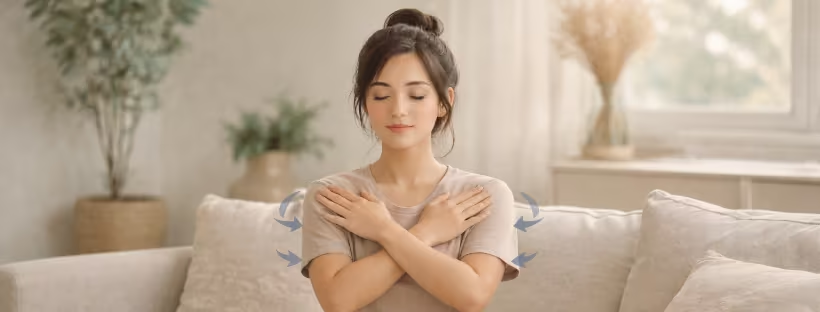
Sometimes your mind knows you’re okay—but your body doesn’t follow.
You can understand the situation logically and still feel tense, restless, or on edge. That’s because the stress response is still active at a physical level.
The Butterfly Hug works by calming the body directly, without needing to think your way out of it.
Cross your arms over your chest and rest your hands on your shoulders.
Gently tap left and right in a slow, steady rhythm for 1–2 minutes.
The alternating movement sends a regulating signal through the nervous system, helping reduce activation and bring the body out of stress mode.
You’re not analysing anything.
You’re giving your body a simple, repetitive pattern that allows it to settle on its own.
4. Vagus nerve humming
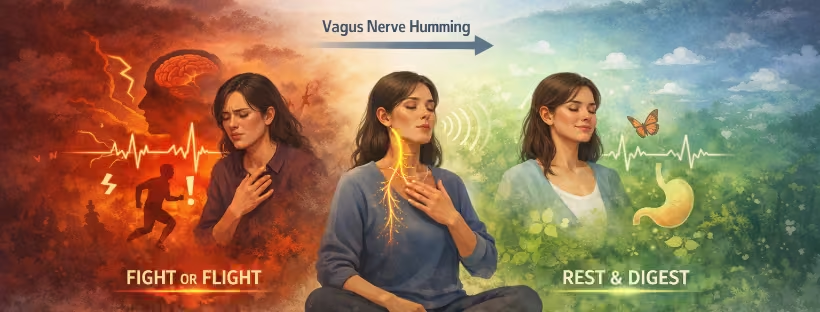
When overwhelm rises, your nervous system often shifts into fight-or-flight mode. Your heart speeds up, your breathing changes, and your body prepares for danger—even if the situation isn’t actually threatening.
One way to interrupt this is vagus nerve humming.
The vagus nerve helps signal to your body when it’s safe to relax. When it’s activated, your system shifts out of stress mode and into a more regulated state.
Humming stimulates this nerve through gentle vibration in the throat and chest.
Take a slow breath in through your nose. As you exhale, hum softly—any tone is fine. Let the sound last for as long as the breath. Repeat for a few breaths.
The vibration helps slow your heart rate and reduce the intensity of the stress response.
5. The 5–4–3–2–1 Grounding Technique

When overwhelm builds, your attention usually leaves the present moment.
It moves into what might happen next, replays what already went wrong, or jumps between multiple thoughts at once. The more your attention stays there, the more your body stays in a stress response.
Grounding works by pulling your attention back to your senses—what is physically around you right now.
Go through the following:
- 5 things you can see
- 4 things you can feel (clothing, chair, floor, air on your skin)
- 3 things you can hear
- 2 things you can smell
- 1 thing you can taste
Be specific with each one. Don’t rush through it.
This forces your brain to shift out of internal thought loops and into real-time sensory input. That shift reduces the intensity of the stress response because your nervous system is no longer reacting to imagined or remembered scenarios.
It’s not about calming yourself down.
It’s about changing what your attention is locked onto—so your body has a reason to come out of stress mode.
Final Thoughts

Staying calm in overwhelming moments isn’t about forcing yourself to relax or pretending everything is fine.
It’s about understanding what your nervous system is doing — and giving it the signals it needs to stand down.
Techniques like the Butterfly Hug, slow breathing, grounding, and body awareness all work in the same way. They shift your body out of survival mode and back toward regulation — the foundation of long-term nervous system healing.
Sometimes that shift is subtle.
Your shoulders drop a little.
Your breathing deepens.
Your thoughts slow down enough for clarity to return.
Those small changes matter.
Because the more often you give your nervous system signals of safety, the easier it becomes for your body to find calm again — even in stressful moments.
Over time, these practices stop being techniques you remember in a crisis.
They become skills your body knows how to use automatically.
And that’s when calm stops feeling like something you have to chase — and starts feeling like something you can return to whenever you need it.
