Best Magnesium for Anxiety and Nervous System Support
How different magnesium forms support anxiety, sleep, and nervous system balance

Magnesium has quietly become one of the most recommended supplements for anxiety and sleep problems, especially in people experiencing nervous system dysregulation.
But most people don’t realize something important: “magnesium” isn’t just one thing.
Different forms affect the body in completely different ways. Some can genuinely help calm an overstimulated nervous system. Others are poorly absorbed and remain mostly in the digestive tract, which means they provide little benefit for the brain or nervous system.
That’s why some people feel dramatically better after taking magnesium… while others feel nothing.
Disclosure: The information provided is for educational purposes only and not intended as medical advice. Consult a qualified healthcare professional before starting any new supplement or making changes to your health routine. I may earn a small commission at no additional cost to you.
Quick Select
Use this table to quickly find the magnesium form best suited for anxiety, nervous system support, energy, or brain health.
| Magnesium Type | Best For | How It Supports the Body | Recommended Product |
|---|---|---|---|
| Magnesium Glycinate | Anxiety & Sleep | Bound to glycine, a calming amino acid that supports relaxation and nervous system balance. | Nutricost Magnesium Glycinate Powder |
| Magnesium Taurate | Nervous System | Combines magnesium with taurine, which helps regulate nerve signaling and stress response. | Gade Nutrition Magnesium Taurate Powder |
| Magnesium Malate | Low Energy | Malic acid supports cellular energy production and helps reduce fatigue from chronic stress. | Seeking Health Magnesium Malate Powder |
| Magnesium L-Threonate | Brain Health | Designed to raise magnesium levels in the brain and support memory and cognitive function. | Life Extension Neuro-Mag Magnesium L-Threonate |
How to Choose the Right Magnesium
If several of these symptoms apply to you, start with the magnesium form that addresses the root cause of your symptoms, not every symptom at once.
Here’s the simplest way to decide:
If your main issue is anxiety, racing thoughts, or poor sleep → choose Magnesium Glycinate.
This is the most commonly recommended form for calming the nervous system.
If anxiety comes with heart palpitations or stress sensitivity → choose Magnesium Taurate.
Taurine helps regulate nerve signaling and cardiovascular stress responses.
If you feel constantly drained or burned out → choose Magnesium Malate.
Malate supports cellular energy production and can help with fatigue.
If brain fog and memory problems are the biggest concern → choose Magnesium L-Threonate.
This form is studied for its potential to increase magnesium levels in the brain.
Best Magnesium Supplements
for Anxiety & Nervous System Support
Not every magnesium supplement is formulated the same way. The options below are widely used forms with straightforward ingredient lists and established manufacturing standards.
1. Magnesium Glycinate

Magnesium glycinate is one of the best forms for anxiety, stress, and sleep support thanks to its high absorption and calming effect on the nervous system.
This product uses pure magnesium bisglycinate with no fillers, making it a clean, straightforward option. The powder format also allows flexible dosing, though it does have a naturally bitter taste.
| Magnesium Form | Magnesium bisglycinate |
| Ingredients | Magnesium bisglycinate |
| Elemental Magnesium | 210 mg per serving |
| Form | Unflavored powder |
| Serving Size | 1 scoop (1.8 g) |
| Servings Per Container | 135 |
| Container Size | 250 g |
| Best For | Anxiety, stress, and sleep support |
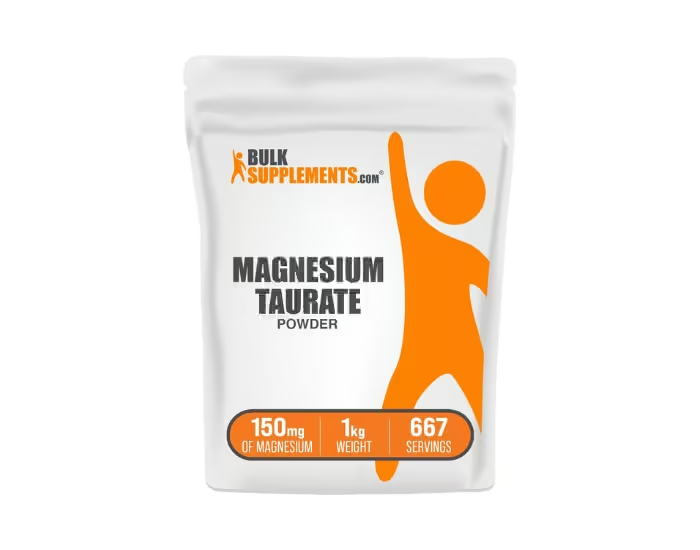
2. Magnesium Taurate

Magnesium taurate is often chosen for nervous system support, particularly when stress is linked to heart palpitations or heightened sensitivity. It combines magnesium with taurine to help regulate nerve signaling and support cardiovascular function.
This product uses pure magnesium taurate with no fillers, making it a clean and simple option. The powder format allows flexible dosing, though it has a naturally bitter taste.
| Magnesium Form | Magnesium taurate |
| Ingredients | Magnesium taurate |
| Elemental Magnesium | 200 mg per serving |
| Form | Unflavored powder |
| Serving Size | 1/2 tsp (about 1,000 mg) |
| Servings Per Container | 250 |
| Container Size | 250 g powder |
| Best For | Heart and nervous system support |
3. Magnesium Malate

Magnesium malate is often chosen for low energy, fatigue, and muscle tension, especially when stress feels physically draining. It combines magnesium with malic acid to support energy production and recovery.
This product uses pure dimagnesium malate with no fillers, making it a clean and simple option. The powder format allows flexible dosing, though it has a naturally bitter taste.
| Magnesium Form | Dimagnesium malate |
| Ingredients | Dimagnesium malate |
| Elemental Magnesium | 100 mg per serving |
| Form | Unflavored powder |
| Serving Size | 1 scoop (2 g) |
| Servings Per Container | 100 |
| Container Size | 250 g |
| Best For | Energy and muscle recovery |
4. Magnesium L-Threonate

Magnesium L-threonate is often chosen for brain fog, memory, and mental clarity, especially during periods of stress. It’s designed to raise magnesium levels in the brain and support cognitive function.
This product uses the well-known Magtein® form, making it a widely used option for brain and nervous system support. It comes in capsule form, which is convenient but includes additional ingredients.
| Magnesium Form | Magnesium L-Threonate (Magtein®) |
| Ingredients | Magnesium L-Threonate (Magtein®), vegetable cellulose (capsule), microcrystalline cellulose, silica, vegetable stearate |
| Elemental Magnesium | 144 mg per serving |
| Form | Capsules |
| Serving Size | 3 capsules |
| Servings Per Container | 30 |
| Container Size | 90 capsules |
| Best For | Brain Function and Cognitive Stress |
How Magnesium Affects the Nervous System and Stress Response

Magnesium plays a central role in how the nervous system responds to stress. It helps regulate several processes that determine whether the body stays calm or shifts into a heightened “fight-or-flight” state.
One of its key functions involves the brain’s calming neurotransmitters. Magnesium supports the activity of GABA, a chemical messenger that signals the nervous system to slow down and relax. When magnesium levels are low, this calming signal becomes weaker, which can make the brain more sensitive to stress and stimulation.
Magnesium also influences the stress response system, often called the HPA axis, which can become disrupted during chronic nervous system stress. This system controls how the body releases stress hormones like cortisol. Adequate magnesium helps keep this response balanced, preventing the body from remaining in a prolonged state of tension after stress occurs.
Because of these roles, low magnesium levels are often associated with symptoms such as:
– anxiety and restlessness
– racing thoughts or difficulty relaxing
– muscle tension and headaches
– heart palpitations
– poor sleep quality
Modern lifestyles can make magnesium deficiency more common than many people realize, particularly in people experiencing burnout and chronic stress. Ultra-processed foods contain far less magnesium than whole foods, and chronic stress increases the body’s demand for it. Over time, this combination can leave the nervous system more easily overstimulated.
For some people, restoring magnesium levels helps the nervous system return to a more balanced state, which is why certain forms of magnesium are often used to support anxiety management and sleep.
Why Some Magnesium Supplements Don’t Work

One of the most common things you’ll hear from people trying magnesium for the first time is this:
“I tried magnesium and nothing happened.”
At first glance, that seems confusing. Magnesium is involved in hundreds of biological processes and is widely recommended for anxiety, sleep problems, and nervous system regulation. So why do some people feel a clear difference while others feel absolutely nothing?
In most cases, the problem isn’t magnesium itself — it’s how the supplement was formulated or used.
The wrong form of magnesium
Many supplements on the market use inexpensive forms such as magnesium oxide.
On paper, magnesium oxide looks impressive because it contains a high percentage of magnesium by weight. However, magnesium oxide has lower bioavailability compared with chelated forms such as magnesium glycinate or magnesium malate. It is widely used in supplements because it is inexpensive to produce and stable in tablet form, not because it is the most effective option for nervous system support.
Other low-cost forms, such as magnesium carbonate, are often used primarily as antacids rather than for restoring magnesium levels in the body.
This is why many people report that magnesium supplements “do nothing” — the compound used in the supplement is not well absorbed.
Forms such as magnesium glycinate, taurate, malate, and L-threonate were developed specifically to improve absorption and direct magnesium toward different physiological systems.
Different forms affect the body differently
Magnesium is always bound to another compound, and that compound influences how the body uses it.
Some forms are used mainly for digestive support, while others are chosen specifically for the nervous system, brain function, or cellular energy production.
For example, magnesium glycinate is commonly used for anxiety and sleep support, magnesium taurate is associated with nervous system and cardiovascular regulation, magnesium malate is often used for energy production, and magnesium L-threonate is studied for its ability to increase magnesium levels in the brain.
Taking a form that isn’t suited to the symptom you’re trying to address can make magnesium appear ineffective.
The dose is too low
Another common issue is dosage.
Many supplements contain relatively small amounts of elemental magnesium, sometimes only 50–100 mg per serving. While this contributes to daily intake, it may not be enough to noticeably influence nervous system regulation, particularly if someone’s diet is already low in magnesium.
People who supplement for stress or sleep support often use amounts closer to 200–400 mg per day, depending on their diet and individual needs.
People with kidney disease or those taking certain medications should consult a healthcare professional before using magnesium supplements.
Magnesium levels don’t change overnight
Magnesium is not a stimulant or sedative that forces an immediate change in the nervous system.
Instead, it supports the systems that allow the body to regulate itself. If magnesium levels in the body have been low for a long time, it can take several days or weeks of consistent intake for levels in tissues and cells to gradually improve.
This is why some people notice subtle improvements over time, such as better sleep, reduced muscle tension, or a calmer stress response.
Supplements often contain unnecessary additives
Many magnesium supplements include manufacturing additives that are not related to magnesium itself.
These can include ingredients such as magnesium stearate, silicon dioxide, artificial flavorings, or various capsule fillers. They are typically added to improve manufacturing, prevent clumping, or extend shelf life.
While these ingredients are widely used in supplement production, they can dilute the amount of magnesium in each serving and make formulations more complicated than necessary.
For this reason, some people prefer simpler supplements that contain only the magnesium compound itself.
Magnesium may not be the only factor, since many everyday factors that dysregulate the nervous system can contribute to anxiety symptoms.
Finally, magnesium is only one piece of the nervous system puzzle.
Anxiety, sleep disturbances, and chronic stress can also be influenced by factors such as sleep deprivation, unstable blood sugar levels, excessive caffeine intake, or prolonged psychological stress.
Anxiety and nervous system regulation are also influenced by the gut microbiome, which plays a role in mood and stress signaling.
Magnesium can support the nervous system, but it works best when it is part of a broader approach to restoring balance.
The bottom line
When magnesium appears to “do nothing,” the issue is usually one of three things: the wrong form, the wrong dose, or not enough time for the body to respond.
Choosing a well-absorbed form and using it consistently often makes a noticeable difference.
Final Thoughts

When the nervous system stays in a constant state of stress, the body often loses its ability to return to a calm baseline. Sleep becomes lighter, thoughts race more easily, and even small stressors can feel overwhelming.
Magnesium can’t remove stress from your life, but it helps support the biological systems that allow the body to recover from it. When magnesium levels are adequate, the nervous system is better able to regulate how strongly it reacts to stress and how quickly it returns to a relaxed state afterward.
For many people, the real difference comes from understanding that not all magnesium supplements behave the same way in the body. Once the right form is used consistently, some people notice improvements in sleep quality, muscle tension, or the general sense of nervous system calm that makes daily stress easier to handle.
If you decide to try magnesium, focus less on finding the highest dose and more on choosing a well-absorbed form that matches the symptoms you’re trying to support. Sometimes the simplest changes — when they align with how the body actually works — are the ones that make the most noticeable difference.