
The Ultimate Nervous System Healing Guide

You’re tired—but your mind won’t switch off.
You finally slow down—but your body doesn’t relax.
Nothing is wrong—but it doesn’t feel that way.
You’re given answers—but they don’t actually connect.
One explanation for your sleep. Another for your energy. Something else for your anxiety, your focus, your digestion.
Each one sounds reasonable on its own.
But no one steps back and shows you how it all fits together.
So you’re left managing symptoms that feel unrelated—when in reality, they’re being driven by the same underlying system.
Your nervous system is what links all of it.
It’s constantly deciding how your body responds, how it uses energy, and whether it prioritises survival or recovery.
And when that system is even slightly off, the effects don’t show up in one place.
They show up everywhere.
This is what most people are never told—and why things can feel confusing, inconsistent, and hard to fix.
Disclosure: The information provided is for educational purposes only and not intended as medical advice. Consult a healthcare professional before making any changes to your health routine. If you make a purchase through the links provided, I may earn a small commission at no additional cost to you.
- What the Nervous System Actually Does
- Why Your Body Feels Stressed
- The Three Nervous System States
- Why You Feel Wired But Tired
- Why Your Body Doesn’t Just “Reset” After Stress
- Why Rest Doesn’t Fix It
- How to Regulate Your Nervous System
- How Long Does It Take to Feel Normal Again?
- ❓ Nervous System Regulation FAQs
What the Nervous System Actually Does
And Why It Affects Everything
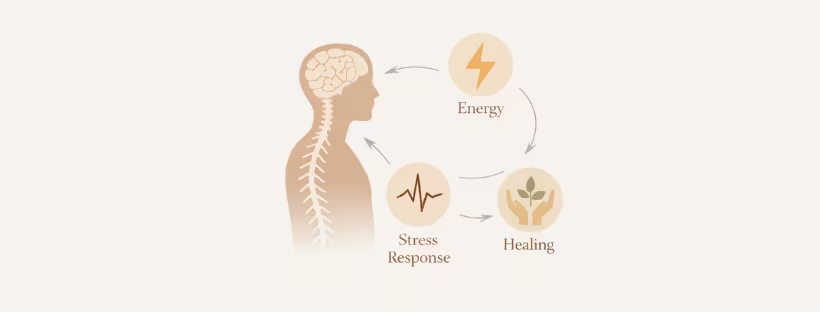
The nervous system is the control system of your body.
It connects your brain to every organ, muscle, and system, constantly sending and receiving information so your body can function, adapt, and respond in real time.
It is not something you consciously control.
It runs in the background, every second of the day, deciding how your body responds, how it uses energy, and what it prioritises.
It regulates far more than you think
Most people associate the nervous system with stress or anxiety.
But its role is much broader.
It is responsible for regulating:
- heart rate
- breathing
- muscle tension
- digestion
- energy production and use
- focus and attention
And it also influences:
- emotions and your sense of safety
- hormone balance, including stress and sleep hormones
- immune function and inflammation
- pain sensitivity
- how well your body repairs and recovers
This means it affects both how you feel mentally and how your body functions physically.
It is constantly scanning and adjusting
Your nervous system is always taking in information.
From your environment.
From your body.
From your past experiences.
It processes this automatically and uses it to make one ongoing decision:
Should the body prioritise survival—or recovery?
Based on that decision, it adjusts everything else.
When your system detects stability
When your body registers enough safety and stability, it shifts into a state that supports:
- digestion
- repair
- hormone balance
- stable energy
- clear thinking
This is where your body maintains itself.
When your system detects demand or stress
When your system detects pressure, unpredictability, or anything it interprets as a potential threat, it shifts in the opposite direction.
It begins to prioritise:
- alertness
- energy mobilisation
- faster responses
- short-term performance
And it temporarily reduces:
- digestion
- long-term repair
- deeper recovery processes
This is not a problem.
It is a built-in response designed to help you handle demand.
The system is designed to move—not stay stuck
Your nervous system is meant to shift between these states throughout the day.
Respond when needed.
Recover when it’s over.
Return to baseline in between.
This flexibility is what keeps your body functioning well.
The vagus nerve and regulation
One of the main pathways involved in this process is the vagus nerve.
It connects your brain to many of your organs and plays a key role in helping your body shift out of stress and back into a more regulated state.
It supports your ability to slow down, recover, and restore balance after activation.
Why this matters
When this system is working well, these adjustments happen smoothly and automatically.
You respond to stress—and then recover from it.
But when the system adapts to ongoing stress, stimulation, or irregular patterns, that flexibility can change.
The body may:
- stay more activated than it should
- recover less completely
- or shift into low energy without fully restoring
Because this system influences so many functions at once, the effects don’t show up in just one place.
They show up as patterns.
Why Your Body Feels Stressed
Even When Nothing Is Wrong

You don’t need something obvious to be wrong for your nervous system to react.
It is constantly asking one question in the background: am I safe right now? And it answers that question before you think about it.
Your body is always scanning—your environment, your internal state, your energy, and your past experiences. This happens automatically, outside of your awareness, but it determines how your body responds.
What most people don’t realise is that your nervous system doesn’t respond only to what is happening. It responds to what feels familiar or expected based on what it has learned over time. That means you can feel stressed, tense, or on edge even when nothing is actually wrong.
This is why it can feel like it comes out of nowhere.
From the outside, nothing triggered it. But internally, your system recognised something—subtle, familiar, or patterned—and responded before you had time to think.
Your nervous system is not waiting for stress. It is trying to stay ahead of it.
If your system has adapted to constant stimulation, pressure, or unpredictability, it learns that staying slightly activated is safer than being caught off guard. Over time, that state begins to feel normal.
This is also why slowing down can feel uncomfortable. When stimulation drops, your body doesn’t immediately register safety—it registers uncertainty. So instead of relaxing, you may feel restless or uneasy.
Nothing is wrong here.
Your nervous system is doing exactly what it was designed to do: detect patterns, predict what’s coming, and keep you prepared.
The issue is not the response. It’s that the system has learned to expect demand.
And because this response happens before thought, it’s not something you can think your way out of.
The shift comes from showing your body—through repeated experience—that it doesn’t need to stay on guard.
The Three Nervous System States
And How to Recognise Yours

Your nervous system moves between three states throughout the day, based on how it answers one question: am I safe right now?
This framework is described in Polyvagal Theory, developed by Stephen Porges, which explains how the body shifts between states of safety, activation, and shutdown. You don’t need to understand the theory for this to be useful—but it helps explain why these patterns are so consistent.
These states are not problems. They are built-in responses designed to help you adapt.
🟢 Regulated (Rest and Digest)
This is the state your body is designed to spend the most time in.
It doesn’t mean perfect calm—it means your system is not actively trying to protect you.
In this state, your body functions efficiently. Breathing is steady, digestion works properly, energy is stable, and your thinking is clear. You can focus, respond, and then switch off without difficulty.
This state is flexible. You can handle stress when it arises—and return again without effort.
🟠 Fight or Flight (Activation)
When your system detects pressure, demand, or unpredictability, it shifts into activation.
This is your body preparing you to respond.
Energy increases, attention narrows, and your body becomes more alert. This can feel like anxiety, overthinking, physical tension, restlessness, or a constant sense of urgency.
You may feel productive in this state—but your body is on alert.
It is designed to be temporary. When it doesn’t resolve, that “wired” feeling can become your baseline.
If activation continues for too long, or doesn’t resolve, your system can shift into shutdown.
Instead of increasing energy, your body reduces output.
This can feel like low energy, heaviness, brain fog, disconnection, or lack of motivation. It’s often mistaken for laziness—but it isn’t.
It’s your nervous system conserving energy when it no longer feels safe to keep pushing.
These are not separate systems—they are different expressions of the same one.
You are meant to move between them: activation when something requires your attention, regulation once it passes, and shutdown only when necessary.
When that movement becomes less flexible, the system starts to stay in one state longer than it should—or cycle between states without fully returning to baseline.
When you understand this, your experience stops feeling random.
You can begin to see what state your body is in—and why.
Why You Feel Wired But Tired
And Why It Doesn’t Go Away

Your nervous system feels off when it stops returning fully to baseline after stress.
Instead of activating and recovering, it stays slightly engaged—or drops into low energy without fully restoring. Over time, this becomes your new normal.
This usually isn’t caused by a single event.
It comes from repeated patterns your body adapts to, such as:
- constant stimulation (screens, noise, task-switching)
- irregular sleep and light exposure
- inconsistent eating or low energy availability
- ongoing mental or environmental stress
These signals keep your system in a state of ongoing demand.
At the same time, recovery becomes less complete.
Periods of true downtime—low stimulation, predictable rhythms, and physical calm—are often reduced or inconsistent. Without these signals, the system doesn’t fully downshift.
So each day starts from a partially activated baseline.
Over time, this changes how your body responds:
- activation becomes easier to trigger
- recovery becomes less effective
- energy becomes less stable
This is why it stays that way.
Not because something is broken—
but because your nervous system is adapting to what it experiences most often.
Why Your Body Doesn’t Just “Reset” After Stress

It seems like it should be simple.
If stress caused this, then removing stress should fix it.
But that’s not how the nervous system works.
Your system doesn’t just respond to stress—it adapts to it.
When stress is repeated over time, your body stops treating it as temporary.
It starts treating it as normal.
This becomes your new baseline.
Instead of activating and fully recovering, your system begins to:
- stay slightly on edge
- recover less completely
- expect ongoing demand
Over time, this becomes your default state.
So even when things are calm, your body doesn’t immediately return to how it used to feel—because it’s no longer calibrated to that baseline.
It’s not failing to reset.
It’s maintaining the pattern it has learned.
This is why rest doesn’t always work the way you expect it to.
Because your nervous system isn’t trying to go back to where it was—
It’s operating from where it has adapted to be.
Why Rest Doesn’t Fix It
And Why Quick Fixes Don’t Last

Rest is often treated as the solution—but rest is not the same as recovery.
Recovery only happens when your nervous system fully downshifts out of activation.
If it doesn’t, you can rest, sleep, or take time off—and still feel tired.
This is why:
- sleep doesn’t always feel restorative
- downtime doesn’t fully relax you
- short-term tools only work temporarily
Most “rest” still includes stimulation—scrolling, watching, switching tasks—which keeps the system slightly engaged.
And most tools change your state briefly, but don’t change the underlying pattern your nervous system has adapted to.
So the system returns to the same baseline.
Not because the tools don’t work—
but because the conditions haven’t changed.
How to Regulate Your Nervous System

Regulation comes from what your body experiences every day. Not one technique. Not a reset button. What changes your nervous system is consistent signals of safety, stability, and recovery.
You don’t need a perfectly calm life to do this. You need enough moments where your body is not under demand. Because the goal isn’t to avoid stress. It’s to make sure stress isn’t the only thing your system experiences.
Eat regularly and early
Your nervous system tracks energy availability as a safety signal. If you wake up, rush out the door, grab coffee, and don’t eat for hours, your body doesn’t interpret that as productivity—it interprets it as stress. Even on busy mornings, eating something within the first hour helps stabilise your system before the day ramps up. This doesn’t have to be complicated. It just needs to be consistent.
Get natural light early in the day
Light is one of the strongest signals your body uses to regulate energy and sleep. If your morning starts indoors, on your phone, and then straight into a commute or work environment, your system never gets that grounding signal. Even 5–10 minutes outside—before checking your phone, before entering a busy space—can help anchor your nervous system before stimulation increases.
Reduce constant stimulation
You may not be able to control your environment. Noise, traffic, notifications, conversations—these are part of modern life. But most people never give their system a break from input at all. Even short pockets where you’re not consuming anything—no phone, no music, no scrolling—allow your system to start downshifting. This might look like standing outside for a few minutes, sitting without distraction, or walking without headphones. Small gaps matter more than perfect conditions. If your environment is consistently high-stimulation, a more noticeable shift often comes from stepping out of it entirely for a period of time—such as a structured nervous system reset retreat, where your body is no longer adapting to constant input but actually given space to recalibrate.
Don’t start your day in a reactive state
If your day is already demanding, this becomes more important—not less. Reaching for your phone first thing, checking messages, emails, or social media, puts your system into activation before your day has even begun. Even a few minutes of quiet before engaging with the outside world can change how your system responds to everything that follows.
Use your body to signal safety
Your nervous system responds faster to physical signals than mental ones. Slow your breathing, release tension in your shoulders and jaw, and allow your body to physically shift out of alertness. This is especially useful in environments you can’t control—on a commute, at your desk, in between tasks. Low levels of key minerals can also make the system more reactive. Magnesium, in particular, plays a role in how easily your body shifts out of stress, which is why choosing the right type of magnesium for anxiety and nervous system support can make a difference.
Create at least one true recovery period daily
Not scrolling. Not watching. Not multitasking. Just low stimulation. If your entire day is filled with input, your system never fully downshifts. Even 10–15 minutes where nothing is required of you can begin to shift your baseline over time.
Reduce stimulation in the evening
If your nights are filled with bright light, screens, and constant input, your system doesn’t transition into recovery—it stays engaged. Lowering light, reducing screen exposure, and creating a quieter environment helps your body move toward sleep more naturally.
Keep your rhythm consistent
Your nervous system responds to predictability. Waking, eating, and winding down at similar times each day reduces the need for constant alertness. Inconsistent patterns keep your system guessing. Consistency tells it what to expect.
What matters most
You don’t need to do everything at once. Start with two or three of these and repeat them daily. Your nervous system doesn’t change based on what you try—it changes based on what you repeat.
How Long Does It Take to Feel Normal Again?

There isn’t a fixed timeline.
It depends on how long your current patterns have been in place—and how consistent your daily signals are now.
Some changes can happen quickly.
Within days or weeks, you might notice:
- slightly better sleep
- more stable energy
- less reactivity
But deeper changes take longer.
As your nervous system adapts, progress tends to look like:
- recovering faster after stress
- fewer extreme highs and lows
- rest starting to feel more effective
- more consistent energy throughout the day
This process is not linear.
You may feel better for a few days, then notice symptoms return. That doesn’t mean it’s not working—it reflects the system adjusting over time.
There isn’t a final “reset” point.
What changes is how stable and responsive your system becomes—and how easily it returns to baseline after stress.
