
What Is Holistic Health—And Why It’s the Missing Link in Modern Wellness

Despite the rise of wellness culture, many people still feel tired, inflamed, anxious—or stuck with symptoms no one can explain. That’s because modern health care often treats the body in parts, chasing symptoms instead of asking why they exist.
Holistic health offers a whole-body approach that connects physical, mental, emotional, and environmental factors—and it may be the missing link in how we understand true wellness.
🔑 Quick Summary
– Holistic health views the body as an interconnected system—physical, mental, emotional, and environmental.
– Unlike conventional care, it focuses on root causes, not just symptoms.
– The core pillars include nutrition, nervous system regulation, sleep, detoxification, emotional health, and environment.
– Subtle signs like fatigue, anxiety, cravings, or bloating are early signals of imbalance—not “normal.”
– Holistic health empowers you to take ownership of your well-being by reconnecting with how your body truly works.
- What Is Holistic Health, and Where Does the Concept Come From?
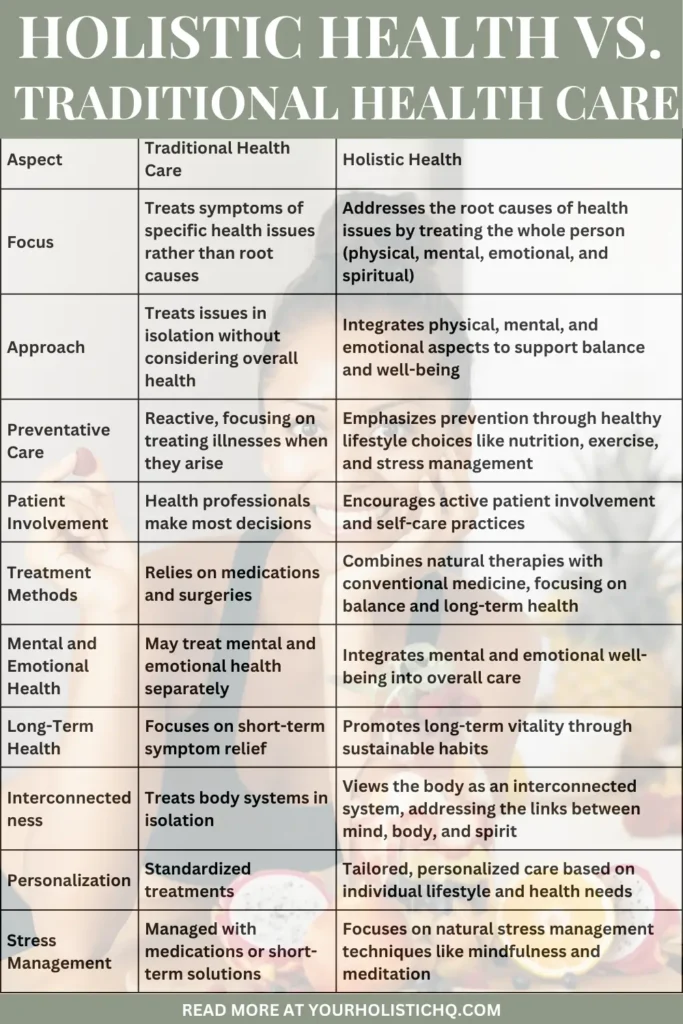
- How Does Holistic Health Compare to Conventional Medical Care?
- What Are the Core Pillars of Holistic Healing?
- How Do You Know When Your Body Is Out of Balance?
- Final Thoughts: Why Holistic Health Isn’t a Trend—It’s a Return to Truth
- Key Takeaways
- ❓ Frequently Asked Questions


What Is Holistic Health, and Where Does the Concept Come From?

Holistic health is a system-based approach to wellness that views the body as an interconnected whole—physical, mental, emotional, and environmental. Instead of isolating symptoms, it looks for root causes, patterns, and imbalances across all systems of the body.
At its core, holistic health is built on one simple truth: everything is connected. Your gut affects your brain. Your sleep influences your immune system. Chronic stress impacts digestion, hormones, and cellular repair. Symptoms don’t appear in a vacuum—they’re responses to something deeper.
A Systems Biology Perspective
Modern science now confirms what ancient systems always knew: the human body is an integrated, adaptive system. In functional and systems biology, this is known as network physiology—where different organs, hormones, and cellular pathways operate in dynamic feedback loops. When one area is imbalanced (e.g. inflammation, nutrient deficiency, chronic stress), the ripple effects are systemic—not isolated.
Holistic health aligns with this view by supporting core systems:
- Digestive health: the root of nutrient absorption, detox, and immunity
- Nervous system regulation: essential for hormone balance, mood, and recovery
- Detoxification pathways: liver, kidneys, lymph, skin—constantly working to keep internal load low
- Emotional processing: stored trauma and repressed emotions can impact physical tissues and immune response
Ancient Roots, Modern Science
Though gaining traction in functional medicine and integrative clinics today, holistic health is not new. The concept dates back thousands of years:
- Ayurveda (India): Emphasized balance between body, mind, and spirit through diet, energy, lifestyle, and herbal medicine.
- Traditional Chinese Medicine: Viewed health as a balance of energy (Qi) moving through organ systems, influenced by emotions and environment.
- Indigenous Healing Practices: Focused on nature, seasonal rhythms, community, and the spiritual root of illness.
What’s different now is the research catching up. We now have:
- PubMed-backed studies on how gut health impacts mental health (the gut-brain axis)
- Data showing how unprocessed emotions affect the nervous system and immune resilience
- Clear links between environmental exposures and endocrine disruption, autoimmunity, and chronic fatigue
The Key Shift: From Reactive to Root-Cause
In conventional medicine, you wait for symptoms, get a diagnosis, and receive treatment—often pharmaceutical. In holistic health, the goal is early detection of imbalance, even before disease develops. It’s not about managing illness. It’s about cultivating resilience.
In other words: conventional health care asks, “What diagnosis fits this?”
Holistic health care asks, “What caused this to begin with?”
And that difference changes everything.
How Does Holistic Health Compare to Conventional Medical Care?

How Does Holistic Health Compare to Conventional Medical Care?
Most people don’t choose a health system.
They inherit one.
From a young age, we’re taught:
• If you’re sick, go to the doctor.
• If there’s a symptom, there’s a medication.
• If it’s not on a lab report, it doesn’t exist.
This is the conventional medical model. And while it can be life-saving in acute situations—emergency surgery, infection, trauma—it was never designed to keep you well.
Conventional Medicine: Treating the Symptom, Not the System
Conventional care is reactive by design. It waits for symptoms, assigns a diagnostic label, then intervenes—typically with pharmaceuticals or procedures. It operates through specialization (cardiologist, dermatologist, psychiatrist), each focusing on a single system in isolation.
But here’s the problem: your body doesn’t operate in isolation.
Chronic fatigue isn’t just “in your head.” It could be driven by poor mitochondrial function, nutrient depletion, nervous system dysregulation, or even chronic viral load.
Acne? It’s not just a skin issue—it could stem from gut imbalance, liver burden, or hormonal chaos.
Anxiety? It might not be a serotonin problem—it could be inflammation, blood sugar swings, or unresolved trauma.
Most conventional protocols won’t ask these questions. If it doesn’t show up in a scan or lab, it’s often dismissed—or medicated.
Holistic Health: Addressing Root Causes Across Systems
Holistic health flips the approach. It asks:
- What’s driving the symptom?
- Which systems are under stress?
- What can we remove, support, or rebalance to restore function?
It’s not anti-medicine—it’s pro-root-cause.
Instead of managing your condition, it works to reverse it by rebuilding resilience across the body’s systems. That includes:
- Nutrition as cellular input, not just calories
- Detoxification as a daily biological process, not a juice cleanse
- Nervous system regulation as a prerequisite for hormonal and immune balance
- Emotion as a biological signal, not a psychological inconvenience
- Environment as an invisible variable (toxins, light, sound, EMFs) that affects physiology
It’s about restoring the conditions for the body to heal itself.
Side-by-Side Comparison
| Conventional Medicine | Holistic Health | |
|---|---|---|
| Goal | Symptom management | Root-cause resolution + prevention |
| Approach | Reactive, disease-centered | Proactive, systems-based |
| Focus | Isolated organs or symptoms | Whole-body integration |
| Primary Tools | Drugs, surgery, diagnostics | Nutrition, lifestyle, detox, regulation |
| Practitioner Role | Authority (diagnose, prescribe) | Partner (educate, empower) |
| Patient Role | Passive recipient | Active participant |
| View of Emotions | Separate from physical health | Integrated into physical, mental, and hormonal balance |
| Treatment Timeline | Short-term intervention | Long-term health building |
Why This Distinction Matters More Than Ever
In the U.S., 6 in 10 adults now live with a chronic disease.
4 in 10 live with two or more.
(Source: CDC)
And yet, the system most people rely on was built to treat acute infections and injuries—not systemic imbalances driven by lifestyle, environment, trauma, and time.
That’s why so many people today say:
“I’ve done all the tests, and they say I’m fine—but I don’t feel fine.”
Because the current system often only flags disease when it’s already fully developed.
Holistic health looks for dysfunction before it becomes disease.
It’s not a trend.
It’s the evolution of health care—one that puts the whole person back at the center.
What Are the Core Pillars of Holistic Healing?

Holistic health isn’t guesswork. It’s built on a clear foundation: support the body’s systems, reduce what burdens them, and restore what helps them thrive.
These aren’t vague ideas—they’re biological inputs your body depends on every single day. When even one is chronically out of balance, symptoms follow. When they work together? That’s where real healing begins.
Here are the 6 core pillars of a holistic lifestyle—and why they matter:
1. Nutrition That Feeds and Repairs
Food is not just fuel—it’s information. Every bite sends signals to your gut, hormones, immune system, and brain.
Holistic nutrition focuses on:
- Whole, minimally processed foods
- Blood sugar balance
- Anti-inflammatory fats
- Nutrient density (especially minerals and fat-soluble vitamins)
It also asks: What’s inflaming you? What are you missing? What’s depleting your system?
2. Nervous System Regulation
If your body thinks it’s in danger, it won’t heal.
Your nervous system controls digestion, hormones, detox, immune response—even how well you sleep.
Holistic health emphasizes daily practices that shift you out of fight-or-flight and into rest-and-repair, such as:
- Breathwork
- Grounding
- Cold/hot exposure
- Somatic movement
Stress isn’t just mental. It’s cellular.
3. Restorative Sleep
Sleep isn’t optional—it’s when your body does the deepest healing.
During sleep, your brain clears waste, your tissues rebuild, and your hormones reset.
Holistic health prioritizes:
- Circadian rhythm alignment
- Blue light reduction after sunset
- Magnesium, GABA, and glycine support
- Nervous system “wind-down” rituals
Without deep sleep, no protocol works long-term.
4. Daily Detoxification Support
Detox isn’t a cleanse—it’s a full-time job your body’s doing 24/7.
But in today’s environment (pesticides, plastics, VOCs, endocrine disruptors), that job is overloaded.
Holistic support includes:
- Clean air, clean water, clean food
- Sweating, movement, lymphatic drainage
- Supporting liver, kidneys, skin, gut, and breath
- Avoiding chemical exposures—not just treating the aftermath
5. Emotional and Energetic Health
Emotions affect physiology.
Unprocessed grief, chronic resentment, or stored trauma can drive inflammation, tension, and immune dysfunction.
Holistic health doesn’t separate the mind from the body—it recognizes:
- Stress shows up in tissues
- Emotional suppression is nervous system dysregulation
- Tools like journaling, therapy, and energy work matter as much as diet or sleep
6. Connection and Environment
You are not separate from your surroundings.
The people you’re with, the light you live under, the noise, the products you use—it all shapes your internal environment.
Holistic health includes:
- Community and social belonging
- Time in nature
- Non-toxic home products
- Circadian light exposure
- Digital boundaries
Healing happens faster when your environment supports it.
Together, these six pillars form the foundation of a resilient body and mind. Holistic health isn’t about doing everything perfectly—it’s about understanding what your system needs, what’s in the way, and what you can change to restore balance.
How Do You Know When Your Body Is Out of Balance?

Most people don’t realize their body is out of balance until something breaks.
But by the time you’re dealing with chronic fatigue, skin issues, bloating, mood swings, or hormonal chaos—it’s not the beginning. It’s the result of long-term imbalance that’s been building quietly for years.
The good news? Your body speaks early—if you know how to listen.
Here are some of the most common signs your body is asking for deeper support:
⚠️ Subtle Signs of Systemic Imbalance
These are often dismissed as “normal” or “just stress”—but they’re not.
- Daily fatigue, even after 8 hours of sleep
- Afternoon crashes or needing caffeine to function
- Bloating, constipation, or irregular digestion
- Brain fog, poor focus, or memory lapses
- Irritability, anxiety, or emotional swings
- Low libido or irregular cycles (for women)
- Getting sick often, or staying sick longer than usual
- Skin issues like acne, rashes, or chronic dryness
- Cravings, especially for sugar, salt, or carbs
- Poor sleep, even when tired
Individually, these might seem minor. But together, they’re signals that your body’s systems—nervous, hormonal, digestive, immune—are out of sync.
What Causes These Imbalances?
In holistic health, the focus is on identifying the root contributors behind the symptoms—not just naming the condition.
Common drivers include:
- Blood sugar dysregulation (spikes and crashes)
- Chronic stress and nervous system dysregulation
- Inflammation (often driven by poor diet or toxin exposure)
- Poor gut health (dysbiosis, low stomach acid, infections)
- Nutrient deficiencies, especially minerals and fat-soluble vitamins
- Environmental toxins from food, water, air, and products
- Unprocessed trauma or repressed emotional patterns
Most of these won’t show up clearly on basic blood work. But they show up in your energy, digestion, mood, and sleep long before disease ever does.
Your Body Is Always Trying to Rebalance
Symptoms aren’t failures.
They’re signals.
Holistic health teaches us that the body is self-regulating and self-healing—when we remove what harms it and support what restores it.
You don’t need to wait for a diagnosis to start healing.
You just need to notice what your body’s been trying to tell you all along.
Final Thoughts: Why Holistic Health Isn’t a Trend—It’s a Return to Truth

Holistic health isn’t some fringe philosophy or wellness trend. It’s how the body has always worked—and how healing has always happened. What’s changed is our environment, our food, our pace of life, and the level of disconnection we now call “normal.”
Real health isn’t found in a pill bottle or a tracking app. It’s built day by day through the choices we make, the systems we support, and the signals we finally start listening to.
If you’re tired of managing symptoms and ready to understand what your body actually needs, this is your starting point.
Holistic health doesn’t ask for perfection.
It asks for awareness.
And that awareness can change everything.
Key Takeaways
- 🧠 Your body is a system, not a collection of parts. Healing happens when systems are supported—not silenced.
- 🚫 Symptoms are messengers—not malfunctions. Ignoring them doesn’t solve them.
- 🥦 Food, sleep, stress, movement, toxins, and emotions all influence your biology.
- 🧬 Most chronic issues don’t need more treatment—they need less interference.
- 🌿 Holistic health is about alignment, not restriction. Support the system, and the symptoms shift.
❓ Frequently Asked Questions
If you found this article useful, you can support the work here.
