
How Environmental Stressors May Be Affecting Your Nervous System
And Why You Might Feel Calmer Away From Home

You sleep better away from home.
You feel calmer outdoors. Certain places seem to drain you for reasons you cannot explain. You walk into some environments and feel fine. Others leave you feeling tense, tired, distracted, or strangely overwhelmed.
Most people do not immediately connect those experiences to their nervous system.
It is easy to assume it is stress, poor sleep, or simply having too much going on.
But your nervous system responds to more than thoughts and emotions. It constantly takes in information from the environment around you — often without you consciously noticing it.
Noise, smells, lighting, visual stimulation, background activity, and the spaces you spend time in can all become part of the information your body processes throughout the day. Most of this happens automatically.
Changing environments also rarely changes just one thing. Sounds change. Smells change. Light changes. Pace changes. The overall sensory environment changes.
That does not mean your home is “bad” or that everything around you is harming you.
But it can help explain why you sometimes feel like a different person depending on where you are.
Disclosure: This article is for informational purposes only and not medical advice. Some links in this article are affiliate links, meaning I may earn a small commission at no extra cost to you. As an Amazon Associate, I earn from qualifying purchases.
1. Air Quality and Chemical Exposure

The air surrounding you is not simply something you breathe. It becomes part of the environment your nervous system continuously interacts with throughout the day.
Unlike food, you do not encounter it occasionally. You breathe it while you sleep, work, exercise, and move through your day. That means the spaces you spend the most time in become repeated environmental inputs your body is constantly responding to.
Modern indoor environments can contain more than many people realize:
- fragrances and perfumes
- candles and air fresheners
- cleaning products
- laundry products
- mold
- smoke
- poor ventilation
- compounds released from furniture, paint, flooring, and household materials
Individually, most of these exposures may not seem significant. The challenge is that they rarely occur in isolation.
A morning routine might include scented shower products, deodorant, skincare, laundry fragrance, cleaning products used around the home, and fragranced environments outside the home. By evening, candles, diffusers, and additional products can become part of the same environment.
What begins as individual products can quietly become a constant background exposure throughout the day.
Fragrance is a good example of this.
On a label, fragrance can sound like one simple ingredient. In reality, it is often used as an umbrella term that may represent a blend of multiple compounds used to create a particular scent profile. Some compounds used in consumer products have raised concerns around issues such as irritation, allergies, and endocrine disruption, while the label itself does not necessarily tell you exactly what is creating the final scent.
That does not automatically mean every fragranced product is harmful. But it does mean there can be a meaningful difference between products designed around minimal ingredients and products designed around creating a sensory experience.
A simple unscented soap with a short, fully disclosed ingredient list serves a different purpose than a heavily fragranced body wash designed around long-lasting scent and experience. A basic cleaner with transparent ingredients is very different from a product designed to make a home smell like spring breeze long after the cleaning itself is finished.
One approach generally reduces unnecessary inputs.
The other can add layers of them.
This matters because your nervous system is constantly gathering signals from the environment around you. Smell has direct connections to areas of the brain involved in memory, emotion, and environmental awareness, while air quality itself can influence comfort, alertness, sleep, and how settled an environment feels.
This may help explain a pattern that sometimes appears after simplifying an environment or reducing repeated exposure. Perfumes suddenly seem stronger. Cleaning aisles feel overwhelming. Products that once felt neutral become easier to notice.
The immediate assumption is often:
“I suddenly became more sensitive.”
Another possibility is that repeated exposure had simply become part of the background. When that background changes, information that once blended in can become easier to notice.
The point is not that every conventional product is creating harm.
The larger point is that air quality and chemical exposure are often experienced as an entire environment rather than one obvious source. And when that environment becomes part of everyday life, your nervous system is responding to it repeatedly — whether you consciously notice it or not.
2. Noise and Background Sound
Noise is easy to overlook because the brain gets used to repeated sounds quickly. But becoming used to a sound is not the same thing as removing it from the environment.
Modern environments often contain constant background noise:
- traffic
- televisions
- phone notifications
- appliances
- construction
- multiple conversations
- city noise
Most of these sounds do not happen in isolation.
A day may begin with an alarm, continue with traffic during a commute, notifications throughout work, music in stores, conversations around you, and television or scrolling in the evening. Individually, each sound may seem insignificant. Together, they create a constant stream of auditory input.
This matters because your nervous system continuously uses sound to monitor the environment around you. Predictable sounds often require less attention, while sudden, competing, or unpredictable sounds can repeatedly pull attention in different directions.
A quiet conversation and music you intentionally chose can feel very different from background television, multiple conversations happening at once, or notifications interrupting throughout the day.
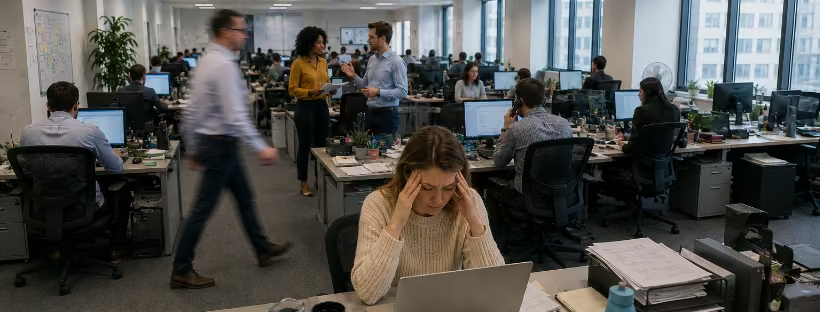
This may help explain why some environments feel unexpectedly draining. A busy restaurant, shopping centre, or open office can leave you feeling tired even when nothing particularly stressful happened there.
The point is not that sound itself is harmful.
The larger point is that many environments keep adding noise throughout the day, and your nervous system may be processing more stimulation than you consciously realize.
3. Artificial Light and Circadian Disruption
Light does more than help you see.
Your body uses light as one of its main environmental signals for determining when to feel awake, alert, and ready for rest. For most of human history, those signals changed naturally throughout the day. Bright daylight was followed by darker evenings and long periods without constant light exposure.
Modern environments look very different.
Common sources of artificial light include:
- fluorescent lighting
- bright overhead lighting
- screens and blue light exposure
- television
- phones and tablets
- reduced exposure to natural daylight
Individually, these may not seem significant. The challenge is that many people now spend most of the day indoors under artificial lighting and continue receiving light exposure long after the sun goes down.
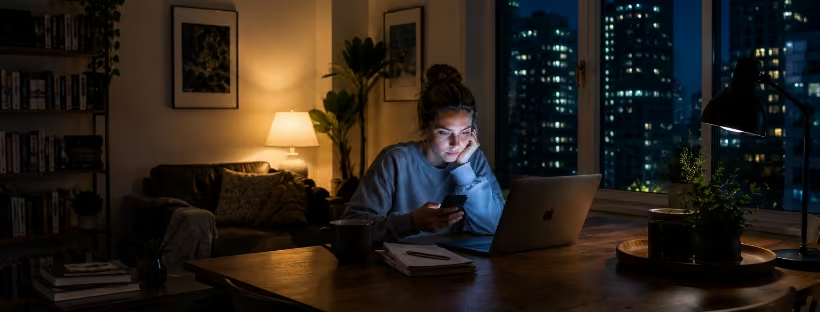
Unlike noise or smell, light is not always experienced as stimulation in the moment. A bright screen in the evening can feel relaxing. Watching television can feel like winding down. Scrolling on a phone can feel quiet and passive.
But your body still uses light as information about the environment around you.
Light exposure during the day generally helps support alertness and circadian rhythms, while lower light levels in the evening help signal that it is time to gradually shift toward rest.
When those signals become less consistent, the body can receive mixed messages.
This may help explain why some people feel tired throughout the day but still struggle to switch off at night, or why spending more time outdoors sometimes feels different in ways that are difficult to explain.
The point is not that screens or artificial light are inherently harmful.
The larger point is that many modern environments expose us to patterns of light that look very different from the environments humans historically experienced, and your nervous system continues responding to those signals whether you consciously notice them or not.
4. Digital and Information Overload
Modern life no longer has the same boundaries it once did.
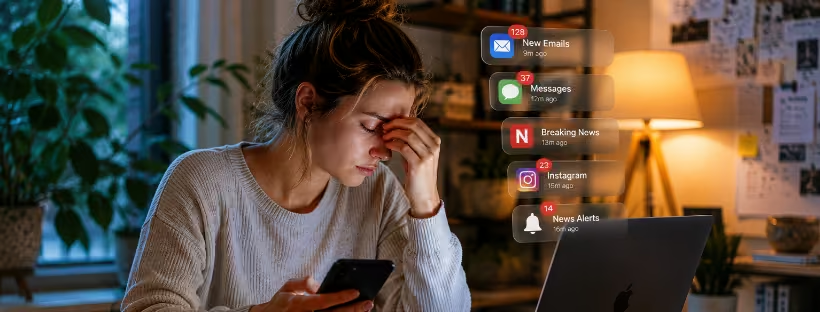
Work follows people home. Messages arrive instantly. News updates appear throughout the day. Social media creates a constant stream of opinions, headlines, images, videos, and notifications competing for attention.
Common sources of digital and information overload include:
- constant notifications
- social media
- emails and messages
- multitasking
- endless scrolling
- being continuously reachable
The challenge is not simply technology itself. It is the amount of information now competing for attention at any given moment.
A quick check of a phone rarely stays one thing for long. One message becomes another. A notification leads to an email. An email leads to social media. A quick scroll turns into twenty minutes.
Attention keeps shifting.
This matters because attention is not unlimited. Your nervous system is continuously sorting through what deserves focus and what can safely be ignored.
Many digital platforms are also intentionally designed to keep people engaged for as long as possible. Infinite scrolling, autoplay, notifications, and algorithm-driven feeds are not accidental features. The longer attention stays engaged, the more time people remain on a platform.
The result is an environment with very few natural stopping points.
This may help explain why mental exhaustion can appear even after sitting at a desk all day, or why rest sometimes stops feeling like rest. Your body may be physically still, while your attention has been moving continuously from one thing to the next.
The point is not that technology itself is harmful.
The larger point is that your nervous system is now responding to an amount of information that looks very different from what previous environments demanded, often without much space between one input and the next.
5. Visually Busy & Overstimulating Environments

Not all environmental stressors come through sound, chemicals, or screens. Sometimes the environment itself simply asks your brain to process more than it needs to.
Common sources of visual overstimulation include:
- clutter
- crowded spaces
- advertising
- excessive movement
- multiple competing visual inputs
- visually chaotic environments
Unlike background noise, visual input often feels invisible because seeing is constant. You are not consciously paying attention to every object in a room, every sign in a store, or every person moving around you.
Your brain is still sorting through it.
It continuously decides what matters, what can be ignored, where attention should go, and what might require a response.
Modern environments can place much heavier demands on that process than people realize.
A shopping centre is a good example. Bright lighting, moving people, signs competing for attention, products covering shelves, advertisements, music, and screens can all exist in the same environment at once.
Nothing is necessarily wrong with any individual part of it.
The challenge is the amount of input arriving at the same time.
This may help explain why some people walk into certain spaces and immediately feel drained, distracted, restless, or like they suddenly need to leave without fully understanding why.
It may also help explain why visually calmer environments often feel different. Less clutter, more open space, and fewer competing inputs can create an environment that requires less constant sorting and filtering.
The point is not that homes need to become perfectly minimal or that every busy environment is creating problems.
The larger point is that your nervous system is constantly responding to what surrounds you, and modern environments can sometimes ask it to process far more visual input than you consciously realize.
Final Thoughts

If you have been feeling tired, overwhelmed, easily overstimulated, or like you feel better in some places than others, it does not automatically mean something is wrong with you.
Your nervous system is constantly responding to the environment around you.
Often it is not one candle, one notification, one noisy room, or one late night on your phone creating the entire picture. Environmental stressors rarely happen alone.
Light, noise, smells, information, and sensory input can all begin stacking together throughout the day.
The goal is not perfection.
The goal is awareness.
Because once you begin noticing what your environment is asking your body to process every day, you can start making changes intentionally instead of assuming you are simply tired, distracted, or “too sensitive.”
If you are wondering where to begin reducing everyday exposure, start small. The biggest shifts often come from the things your body encounters repeatedly rather than trying to change everything at once.
