
You’re Sleeping—But Not Resting
Best Non-Toxic Bedding That Actually Makes a Difference

You fall asleep—but don’t stay asleep.
You wake up too warm. Or slightly irritated. Or just not fully rested.
Nothing extreme. Just enough to notice.
At some point, it stops feeling like a routine issue and starts feeling like something around you isn’t working.
If you’ve already tried the usual fixes and still wake up slightly off—your bedding may be one of the most overlooked causes.
And it’s often the simplest thing to fix.
Your body doesn’t switch off when you fall asleep. It’s constantly adjusting—especially temperature.
This process—often referred to as temperature regulation—is what allows you to stay in deeper sleep cycles.
To stay asleep, your body needs to cool slightly and remain stable. If heat builds up around your skin, it reacts—quietly pulling you out of deeper sleep.
Not fully awake. But not fully restored.
Some fabrics make this worse. They trap heat, hold moisture, or sit on your skin in a way your body keeps adjusting to.
Individually, it’s subtle. Over a full night, it adds up.
Most people assume this is stress. Or hormones. Or something deeper.
But in many cases, it’s much simpler.
It’s the layer your body is in contact with for eight hours a night.
And once you notice the difference, it’s hard to ignore what was disrupting your sleep before.
Disclosure: The information provided is for educational purposes only and not intended as medical advice. Consult a qualified healthcare professional before starting any new supplement or making changes to your health routine. I may earn a small commission at no additional cost to you.
How Different Bedding Materials Affect Your Sleep
Most bedding is designed to feel good when you first get into bed.
What matters is how it behaves a few hours later—when your body is trying to stay settled, cool, and undisturbed.
That’s where the difference shows up.
Linen (best for overheating and night sweats)
Linen allows air to move freely around your body and releases heat instead of holding onto it. If your temperature rises during the night, it dries quickly rather than staying damp against your skin.
→ You stay cooler, with fewer wake-ups from overheating
Organic cotton (best for sensitive skin and everyday comfort)
Organic cotton is breathable and soft, staying stable against the skin over time without trapping excess heat.
→ Sleep feels consistent, without irritation or subtle discomfort
Wool or alpaca (best for temperature stability through the night)
Unlike lighter fabrics, wool and alpaca don’t just release heat—they help regulate it. They adapt as your body temperature changes, keeping you from overheating or getting too cool.
→ Your sleep stays more stable, with fewer subtle wake-ups
Polyester or synthetic blends (most common hidden issue)
Synthetic fabrics tend to trap heat close to your body and hold onto moisture rather than releasing it. They’re often marketed as “cooling,” but that effect usually doesn’t last through the night.
→ You fall asleep fine—but wake up warm, restless, or slightly off
Why “Cooling” Sheets Don’t Work Long-Term
Many “cooling” sheets are designed to feel cold when you first lie down—but that initial sensation doesn’t reflect how they perform over a full night.
As your body temperature changes, these materials often:
- stop releasing heat effectively
- begin holding moisture
- lose their initial feel after washing
→ They may feel good at first—but don’t support deep, uninterrupted sleep
What Non-Toxic Bedding Actually Means
“Non-toxic” isn’t just about the material—it’s about how much the fabric has been altered.
Most bedding goes through some level of processing. The difference is how much is added—and whether the material can still breathe and regulate temperature naturally.
In practice, the goal is simple:
Choose materials that are breathable, stable, and minimally altered—so your body doesn’t have to keep adjusting to them through the night.
Instead of overthinking labels, look at how the product is described.
Watch for:
- “Cooling” or performance claims
- Wrinkle-resistant or stain-resistant features
- Unusually soft feel straight out of the box
- Blended fabrics (e.g. cotton + polyester)
- Vague or missing certification details
Look for:
- GOTS-certified organic cotton
- Linen made from flax
- Wool or alpaca layers
- Simple, clear material descriptions
- No emphasis on added features
How to Choose Non-Toxic Bedding That Actually Works
Now that you know how different materials behave, the choice becomes much simpler.
Match the material to what you’re experiencing:
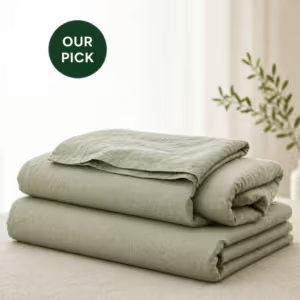
Avocado Linen Sheets
- 100% European flax linen
- Breathable and moisture-wicking
- Gets softer with every wash
→ Stops the overheating → waking repeat cycle
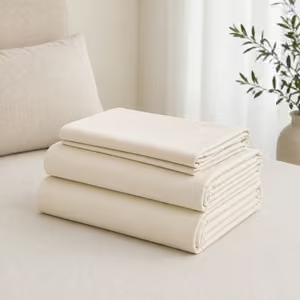
Avocado Organic Cotton Sheet Set
- 100% GOTS-certified organic cotton
- Soft and breathable on skin
- No dyes or chemical finishes
→ Gentler on skin overnight
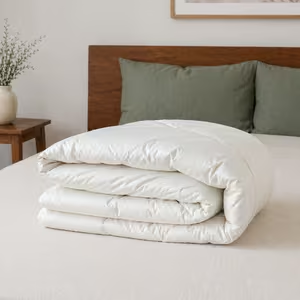
Alpaca Duvet Insert
- Natural alpaca fiber fill
- Regulates temperature naturally
- GOTS-certified organic cotton cover
→ Supports deeper, more stable sleep
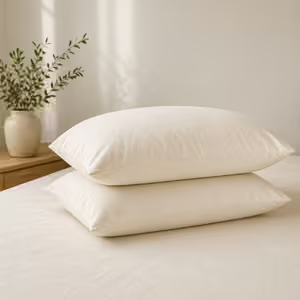
Avocado Organic Cotton Pillowcase
- 100% GOTS-certified organic cotton
- Soft and breathable
- Simple ugrade
→ Easy first step without overhauling your setup
If you’ve fixed your bedding and still feel wired at night
Sometimes it’s not just the fabric—it’s how your body is settling at night.
If your sleep still feels light or restless, it’s worth looking at your nervous system and how your body is responding to your environment.
In that case, adding gentle weight (like a heavier duvet) or improving mattress support can help create a more stable sleep environment.
You don’t need to change everything.
Start with the layer that’s most likely causing the issue.
For most people, that shift alone is enough to make sleep feel noticeably different—less heat, less irritation, fewer wake-ups through the night.
And once your body stops working to compensate, sleep becomes something that actually restores you again.
If you’re starting to look at your environment more broadly, the first changes that matter most in low-tox living are usually the ones your body is exposed to every day.
