7 Quick Mindfulness Practices for Busy Days

Mindfulness isn’t about finding hours of free time—it’s about making the most of the moments you have. These seven quick practices are designed to bring calm, clarity, and focus into your day, no matter how busy it gets. In less than ten minutes, you can refresh your mind, ease stress, and stay connected to the present.
Disclosure: The information provided is for educational purposes only and not intended as medical advice. Consult a healthcare professional before making any changes to your health routine. If you make a purchase through the links provided, I may earn a small commission at no additional cost to you.

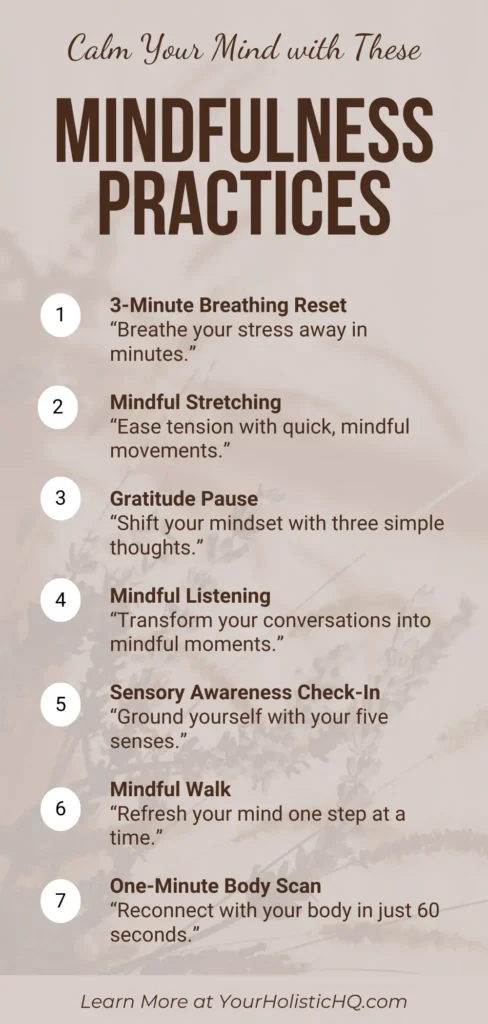
1. 3-Minute Breathing Reset

The power of mindful breathing lies in its simplicity. By focusing on your breath, you can create a moment of calm amid the chaos of a busy day. This practice helps regulate your nervous system, reduces stress, and brings your attention back to the present moment.
To begin, find a quiet space where you can sit comfortably. Inhale deeply through your nose for four counts, hold your breath for four counts, and then exhale slowly through your mouth for six counts. Repeat this cycle for three minutes, letting your thoughts come and go without judgment. Focus entirely on the rhythm of your breath.
As you conclude, notice how your body feels—lighter, calmer, and more grounded. This simple practice can be done anytime, whether at your desk or in a crowded space, making it an easy yet effective tool to reset and recharge your day.
| 1 | Prepare Your Space Find a quiet, comfortable spot where you can sit without distractions. |
| 2 | Begin the Breathing Cycle – Inhale deeply through your nose for four counts. – Hold your breath for four counts. – Exhale slowly through your mouth for six counts. Repeat this cycle for three minutes, focusing entirely on your breath and letting any thoughts pass without judgment. |
| 3 | Conclude and Reflect After three minutes, notice how your body feels. Observe the sense of lightness, calmness, and grounding. This practice can be done anywhere, whether at work, home, or on the go, to quickly reset and recharge your day. |
2. Mindful Stretching

Mindful stretching is a powerful way to release tension and reconnect with your body. By pairing gentle movements with focused awareness, you can ease physical discomfort while cultivating mental clarity. This practice is particularly effective for breaking up long periods of sitting or addressing stress-induced stiffness.
Start by standing or sitting in a comfortable position. Slowly stretch your arms overhead, feeling the length in your spine. Roll your shoulders back and down, and tilt your head gently from side to side. Pay close attention to the sensations in your muscles as they lengthen, and match each movement with a deep, steady breath. Let your stretches be fluid and intuitive, following what feels good for your body.
As you finish, take a moment to notice how your body feels more relaxed and your mind quieter. Just a few minutes of mindful stretching can refresh your energy and help you approach the rest of your day with renewed focus and ease.
| 1 | Prepare Your Position Stand or sit in a comfortable position where you have enough space to move freely. |
| 2 | Begin Gentle Stretches – Slowly stretch your arms overhead, feeling the length in your spine. – Roll your shoulders back and down. – Tilt your head gently from side to side. Focus on the sensations in your muscles as they stretch and lengthen. Match each movement with deep, steady breaths, and let the stretches flow naturally, guided by what feels good for your body. |
| 3 | Reflect on the Experience When you finish, take a moment to notice how your body feels more relaxed and your mind quieter. A few minutes of mindful stretching can refresh your energy and prepare you to tackle the rest of your day with renewed focus and ease. |
3. Gratitude Pause

Gratitude is a simple yet profound way to shift your perspective and bring positivity into your day. By intentionally reflecting on what you’re grateful for, you can counteract stress and cultivate a sense of abundance. This practice is quick, impactful, and requires no tools—just your attention.
Take a moment to pause and think of three things you are grateful for. These can be as small as a kind gesture from a stranger or as significant as the support of loved ones. Focus on the details—how they made you feel, the circumstances that brought them into your life, and why they matter to you. Allow yourself to fully experience the emotion of gratitude as you reflect.
As you conclude, notice how your mindset has shifted. A simple gratitude pause can infuse your day with more joy and resilience, reminding you to find beauty in both the big and small moments of life.
| 1 | Pause and Reflect Take a moment to pause, find a quiet space, and focus your attention inward. Think of three things you are grateful for. |
| 2 | Focus on the Details Reflect deeply on each moment of gratitude. Consider how it made you feel, the circumstances that brought it into your life, and why it matters to you. Allow yourself to fully experience the emotion of gratitude as you think. |
| 3 | Conclude and Notice the Shift As you finish, notice how your mindset has shifted. A gratitude pause can bring more joy and resilience to your day, helping you find beauty in both the small and significant moments of life. |
4. Mindful Listening

Mindful listening is an underrated skill that strengthens connections and enhances understanding. By being fully present in conversations, you show genuine respect and care while cultivating your own mindfulness. This practice fosters deeper relationships and helps you communicate more effectively.
To practice, begin by focusing entirely on the speaker during your next conversation. Resist the urge to think about your response or let your mind wander. Pay attention to their words, tone, and body language, observing the emotions and meaning behind what they’re sharing. If you find your mind drifting, gently bring your focus back to them.
As the conversation ends, reflect on how it felt to be truly present. You may notice a deeper connection or gain insights you might have missed otherwise. Mindful listening benefits both the speaker and the listener, creating space for meaningful and authentic interactions.
| 1 | Focus on the Speaker During your next conversation, give your full attention to the speaker. Avoid thinking about your response or letting your mind wander. |
| 2 | Pay Attention to Details Listen carefully to their words, tone, and body language. Observe the emotions and meaning behind what they’re sharing. If your mind drifts, gently bring your focus back to the speaker. |
| 3 | Reflect on the Experience As the conversation concludes, reflect on how it felt to be truly present. Notice any deeper connections or insights you gained. Mindful listening enriches both the speaker and listener, fostering meaningful and authentic interactions. |
5. Sensory Awareness Check-In

A sensory awareness check-in is a quick and effective way to anchor yourself in the present moment. By tuning into your senses, you can quiet mental chatter and ground yourself in your immediate environment. This practice is particularly helpful during moments of overwhelm or distraction.
Start by pausing wherever you are and focus on your five senses. Notice five things you can see around you, four things you can touch, three things you can hear, two things you can smell, and one thing you can taste. Move through each sense deliberately, paying attention to the details—textures, colors, sounds, and scents. There’s no need to rush; allow yourself to experience each sensation fully.
As you complete the check-in, observe how your mind feels clearer and your body more present. This simple exercise can be done anywhere, from your workspace to a crowded street, offering a moment of calm whenever you need it most.
| 1 | Pause and Focus Pause wherever you are and prepare to focus on your five senses. Take a moment to center yourself and shift your attention to your surroundings. |
| 2 | Engage Your Senses – Identify five things you can see around you. – Notice four things you can touch and feel their texture. – Listen for three distinct sounds in your environment. – Identify two scents you can smell. – Recognize one thing you can taste. Move through each sense deliberately, paying attention to the details of each sensation. |
| 3 | Reflect and Ground After completing the sensory check-in, observe how your mind feels clearer and your body more grounded. This simple practice can be done anywhere to create a moment of calm and presence. |
6. Mindful Walk

A mindful walk is a simple yet transformative way to reconnect with the present moment while incorporating gentle movement into your day. By shifting your focus from your thoughts to your surroundings, you can ease mental tension and refresh your mind.
Begin by stepping outside or finding a quiet space to walk, even if it’s just a short distance. As you walk, focus on the rhythm of your steps and the sensation of your feet touching the ground. Notice the world around you—the sounds of nature, the feel of the breeze, or the textures of the path beneath you. Let each step anchor you further into the present.
As your walk concludes, take a moment to reflect on how your body feels lighter and your mind clearer. A mindful walk, even for a few minutes, can provide a valuable reset, allowing you to return to your day with renewed focus and a sense of calm.
| 1 | Find a Walking Space Step outside or find a quiet space where you can walk, even if it’s just a short distance. |
| 2 | Focus on the Walk – Pay attention to the rhythm of your steps and the sensation of your feet touching the ground. – Notice your surroundings: the sounds of nature, the feel of the breeze, or the textures beneath your feet. – Let each step anchor you further into the present moment, shifting your focus away from your thoughts. |
| 3 | Conclude and Reflect As your walk concludes, reflect on how your body feels lighter and your mind clearer. Even a brief mindful walk can reset your energy and bring a sense of calm and focus to the rest of your day. |
7. One-Minute Body Scan

A one-minute body scan is a quick and effective way to release tension and reconnect with your physical self. By bringing awareness to different areas of your body, you can identify stress points and promote relaxation in moments of busyness.
Begin by sitting or lying down comfortably. Close your eyes and take a deep breath. Start at the top of your head and slowly move your attention downward, scanning your forehead, jaw, neck, and shoulders. As you focus on each area, notice any tension or discomfort and breathe into it, imagining the stress melting away. Continue this process through your arms, torso, legs, and feet.
When you finish, take a final deep breath and open your eyes. Observe how your body feels more relaxed and connected. This brief practice is a powerful tool to reset both physically and mentally, offering a calming pause to recharge during your day.
| 1 | Get Comfortable Sit or lie down in a comfortable position. Close your eyes and take a deep, calming breath to prepare for the body scan. |
| 2 | Scan Your Body – Start at the top of your head and move your attention downward. – Focus on your forehead, jaw, neck, and shoulders. – Continue through your arms, torso, legs, and feet. – As you focus on each area, notice any tension or discomfort. Breathe into these areas, imagining the stress melting away with each exhale. |
| 3 | Conclude and Reflect Take a final deep breath and open your eyes. Notice how your body feels more relaxed and connected. This one-minute body scan provides a quick reset, helping you recharge physically and mentally during your day. |
Final Thoughts

Mindfulness doesn’t require hours of free time or elaborate rituals. By integrating these quick and simple practices into your routine, you can experience profound shifts in your mental clarity, emotional balance, and overall well-being. Each technique offers a moment to pause, reflect, and reconnect with the present, no matter how busy your day may be.
The beauty of mindfulness lies in its adaptability. Whether you’re at your desk, in a meeting, or on a walk, these practices fit seamlessly into any schedule. Over time, they can become habits that support a more centered and holistic way of living, helping you navigate your day with calm and purpose.
Explore what resonates most with you and start small. Mindfulness is a journey, not a destination, and each mindful moment is a step toward greater awareness and balance. For more insights on integrating mindfulness into your life, explore our other guides on self-reflection and holistic wellness.