The Ultimate Nervous System Healing Guide

You sleep, but you still wake up tired.
You finally slow down, but your body never seems to fully relax.
Small things that never used to bother you suddenly feel overwhelming. Your energy feels less predictable. Concentration becomes harder. Recovery takes longer than it once did.
So you start looking for answers.
Maybe it is stress.
Maybe it is sleep.
Maybe it is burnout, hormones, diet, or simply having too much on your plate.
What often makes the situation confusing is that several things seem to change at the same time. Sleep, energy, focus, stress tolerance, and recovery can all feel different, making it difficult to understand how they relate to one another.
The body is complex, and there is rarely one explanation behind every symptom or experience.
However, one system plays a central role in helping the body respond, adapt, recover, and maintain balance from moment to moment.
That system is the nervous system.
Understanding how it works can help explain why certain patterns develop, why symptoms can sometimes feel connected, and what nervous system healing actually means.
Disclosure: This article is for informational purposes only and not medical advice. Some links in this article are affiliate links, meaning I may earn a small commission at no extra cost to you. As an Amazon Associate, I earn from qualifying purchases.
- What Is the Nervous System?
- The Different Parts of the Nervous System
- Why Seemingly Unrelated Symptoms Can Be Connected
- What Happens Under Stress?
- What Is Nervous System Dysregulation?
- How the Nervous System Learns and Changes (Neuroplasticity)
- What Is Nervous System Healing?
- Final Thoughts
- ❓ Nervous System Regulation FAQs
- Related Articles
What Is the Nervous System?
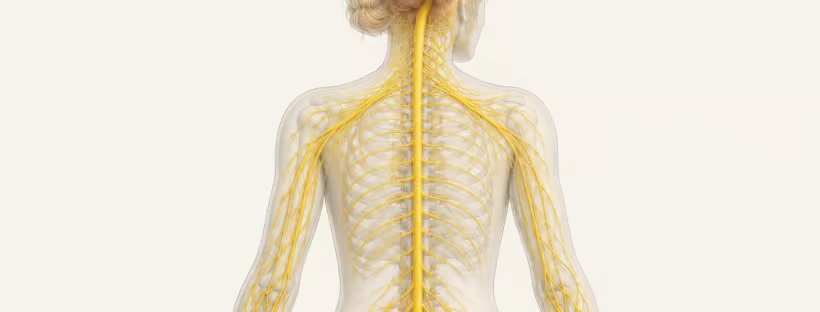
Imagine trying to run an entire city with no roads, no phone lines, no internet, and no way for different departments to communicate with each other.
Hospitals would not know where emergencies were happening. Traffic lights would stop coordinating movement. Power stations would not know where electricity was needed.
The body would face a similar problem without the nervous system.
The nervous system is the body’s communication and coordination network. It is made up of the brain, spinal cord, and a vast network of nerves that extend throughout the body. Its role is to detect changes, send signals between different parts of the body, and help coordinate appropriate responses.
Every moment, the nervous system helps the body respond to changing conditions both inside and outside of you.
For example, it helps you react to things happening around you, such as a loud sound, a bright light, a change in temperature, or someone calling your name. At the same time, it helps monitor countless processes happening within the body, including hunger, pain, breathing, heart rate, and digestion.
These signals allow the body to continually adjust to what is happening from moment to moment.
One of the main goals of these adjustments is to help maintain homeostasis. Homeostasis refers to the body’s ability to keep important functions within a healthy range despite constant changes inside and outside the body. The nervous system plays a major role in helping coordinate these adjustments.
You decide to stand up and walk across the room.
At the same time, countless other processes continue in the background.
• Your heart keeps beating
• Your lungs keep breathing
• Muscles coordinate movement
• Your eyes adjust and focus
• Your body regulates temperature
• Digestion continues working
Most of this happens automatically without conscious effort.
The nervous system helps coordinate all of these activities so different parts of the body can work together rather than independently.
Without it, there would be no reliable way for the brain, organs, muscles, and other tissues to stay connected and respond to changing needs.
To make this possible, the nervous system is organized into different parts that work together continuously.
The Different Parts of the Nervous System
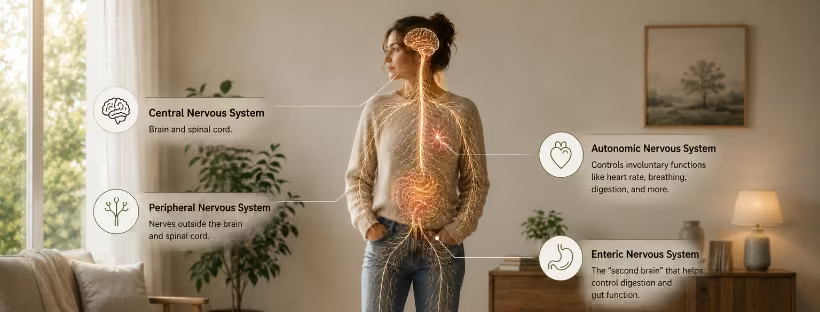
The nervous system is not one single structure performing one single job.
It is a complex communication network made up of several interconnected systems that work together continuously.
Some parts process information. Others carry signals throughout the body. Others help regulate functions that occur automatically in the background.
- Central Nervous System (CNS) — Consists of the brain and spinal cord. It serves as the body’s primary control center, processing information and coordinating responses.
- Peripheral Nervous System (PNS) — Consists of the nerves that extend throughout the body. It carries information between the brain, spinal cord, muscles, organs, and tissues.
- Somatic Nervous System — The part of the nervous system involved in voluntary movement and conscious sensory information such as touch, temperature, and pain.
- Autonomic Nervous System (ANS) — The part of the nervous system responsible for regulating automatic functions such as breathing, heart rate, blood pressure, digestion, and temperature regulation.
- Sympathetic Nervous System — A branch of the autonomic nervous system involved in increasing alertness and mobilizing energy when greater action or attention is required.
- Parasympathetic Nervous System — A branch of the autonomic nervous system involved in recovery, restoration, maintenance, and energy conservation.
- Enteric Nervous System — A large network of nerves located throughout the digestive tract that helps regulate digestion and communicates closely with the brain and the rest of the nervous system.
Although these systems have different roles, they work together continuously to help the body respond and adapt to changing conditions.
Why Seemingly Unrelated Symptoms Can Be Connected

The body does not operate as a collection of isolated systems working independently from one another.
Sleep, energy, digestion, movement, recovery, attention, and stress responses all influence one another to varying degrees.
As a result, changes in one area can sometimes affect several others.
For example:
• Poor sleep can affect energy, concentration, mood, appetite, and recovery
• Ongoing stress can influence digestion, breathing patterns, muscle tension, and sleep quality
• Chronic pain can affect movement, focus, emotions, and daily energy levels
• Reduced physical activity can influence sleep, mood, and overall resilience
This is one reason people sometimes notice changes across multiple areas of health at the same time.
Rather than appearing completely independently, symptoms can sometimes form part of a broader pattern.
This does not mean every symptom has the same cause.
It also does not mean every health problem can be explained by the nervous system alone.
The body is complex, and many factors can influence how a person feels.
What is important to recognize is that symptoms do not always occur in isolation.
Sometimes understanding the broader pattern provides more useful clues than focusing on a single symptom by itself.
This perspective becomes especially important when looking at how the nervous system responds and adapts to stress over time.
What Happens Under Stress?
Nervous System States Explained

When the nervous system detects a challenge, demand, or potential threat, it adjusts how the body operates.
Different situations require different responses. The body does not respond the same way during sleep as it does during exercise. It does not respond the same way during a relaxing conversation as it does during a near-miss while driving.
To help the body adapt, the nervous system shifts between different states.
These shifts are not a flaw.
They are a normal part of how the nervous system helps you respond to changing circumstances.
Fight or Flight
Fight or Flight is the body’s activation state.
Its purpose is to help you respond to situations that require increased energy, attention, or action.
During this state, the body may:
• Increase alertness
• Raise heart rate
• Increase breathing rate
• Direct more energy toward muscles
• Temporarily reduce activities that are less important for immediate action, such as digestion
People often associate Fight or Flight with emergencies, but it is active during many everyday situations as well.
Examples include:
• Taking an exam
• Giving a presentation
• Reacting quickly while driving
• Meeting a tight deadline
Fight or Flight is not necessarily a sign of danger.
It is simply one way the body prepares to meet a challenge.
Rest and Digest
Rest and Digest is the body’s recovery state.
When the nervous system determines that immediate action is no longer needed, it can shift more resources toward maintenance, repair, and restoration.
During this state, the body may:
• Slow heart rate
• Support digestion
• Conserve energy
• Promote recovery and repair
• Support social connection and relaxation
This is the state most closely associated with recovery and many of the processes that help support long-term health.
Freeze
Freeze is another protective response.
Rather than preparing for action, the body may respond to overwhelming situations by reducing movement, conserving energy, or creating a sense of disconnection.
People often describe freeze as feeling:
• Stuck
• Numb
• Shut down
• Unable to take action
Some people experience freeze as feeling unable to think clearly, make decisions, or move forward even when they want to.
Like Fight or Flight, freeze is not a mistake.
It is a protective response that developed to help humans survive difficult situations.
What Is Nervous System Dysregulation?
When Returning to Baseline Becomes More Difficult

Nervous system dysregulation occurs when the body has difficulty settling after stress, challenge, or increased demand.
A healthy nervous system can become more alert when action is needed and gradually settle again once that need has passed.
Dysregulation does not mean the nervous system is broken.
It simply means the body is spending more time in states of activation or protection and having greater difficulty returning to recovery.
Survival Mode
Survival mode is a state in which the nervous system prioritizes protection over recovery.
Rather than easily shifting back into rest and recovery after a challenge has passed, the body continues operating as though it still needs to remain prepared, alert, or responsive.
This response can be helpful in the short term.
However, when it persists for long periods, it can begin affecting how a person feels, functions, and recovers from everyday demands.
When the Nervous System Stays Switched On
For some people, dysregulation shows up as ongoing activation.
The body continues behaving as though it needs to remain alert, prepared, or ready to respond.
People may notice:
• Racing thoughts
• Restless sleep
• Increased sensitivity to stress
• Difficulty relaxing
• Feeling constantly busy internally
• Feeling tired but unable to switch off
When the Nervous System Begins to Shut Down
Not everyone experiences dysregulation as constant activation.
Sometimes the body moves in the opposite direction.
Instead of feeling constantly alert, a person may feel exhausted, emotionally flat, disconnected, or unable to engage fully with daily life.
People may notice:
• Low motivation
• Brain fog
• Fatigue
• Emotional numbness
• Feeling disconnected from themselves or others
Although this can feel very different from being constantly on edge, both experiences can reflect a nervous system struggling to recover and regain flexibility.
Chronic Stress and Burnout
Stress is not always a single event.
For many people, stress becomes part of everyday life.
Work demands, financial pressures, caregiving responsibilities, poor sleep, ongoing health concerns, relationship difficulties, and constant stimulation can place repeated demands on the nervous system over time.
When recovery consistently falls behind those demands, dysregulation can become more noticeable.
Sleep may feel less restorative. Energy may become less predictable. Everyday responsibilities may begin feeling more difficult than they once did.
When these patterns continue for long periods, some people eventually describe the experience as burnout.
The encouraging news is that dysregulation is not necessarily permanent.
The nervous system remains capable of learning, changing, and developing new patterns over time.
Understanding how that process works begins with a concept known as neuroplasticity.
How the Nervous System Learns and Changes (Neuroplasticity)

One of the most important things to understand about the nervous system is that it is not fixed.
It can change throughout life.
Professionals use the term neuroplasticity to describe this ability. Neuroplasticity refers to the nervous system’s capacity to learn, adapt, and reorganize itself in response to experience.
Most people have experienced this without realizing it.
Think about learning to ride a bicycle.
At first, every movement requires conscious effort. You have to think about balance, steering, and timing. The process feels awkward because your nervous system is still learning the pattern.
With enough repetition, something changes.
Eventually, the skill becomes familiar. You no longer need to think through every movement because your nervous system has learned what to do.
The same process applies to far more than physical skills.
The nervous system learns through experience and repetition. Over time, it becomes more efficient at patterns that occur frequently.
This is one reason certain habits, reactions, routines, and behaviors can begin to feel automatic.
One idea sits at the center of neuroplasticity:
The nervous system does not necessarily learn what is best.
It often learns what is repeated.
This helps explain why familiar responses can sometimes continue even when circumstances have changed.
A person may logically understand that a situation is different, yet still notice old habits, reactions, or patterns appearing automatically.
These experiences do not necessarily mean something is wrong.
They often reflect a nervous system using pathways that have become familiar through repetition.
The encouraging part is that familiarity does not mean permanence.
The same ability that allows the nervous system to learn patterns also allows it to learn new ones.
Understanding neuroplasticity helps explain why change is possible. Just as patterns develop gradually through repeated experiences, new patterns can develop through repeated experiences as well.
This idea forms an important foundation for understanding nervous system healing and recovery.
What Is Nervous System Healing?

After learning about stress responses, nervous system dysregulation, and neuroplasticity, an important question naturally follows:
What does nervous system healing actually mean?
Many people imagine healing as reaching a point where stress disappears, difficult emotions never happen, and the body remains calm all the time.
That is not how the nervous system works.
The nervous system naturally moves through a wide range of states. Stress responses such as Fight or Flight are not signs that something is wrong. They are normal parts of how the body adapts to challenges and changing circumstances.
Healing is not about avoiding these states.
It is about developing the ability to move through them more effectively.
A healthy nervous system can become activated when action is needed, settle when the situation has passed, and shift between different states with greater flexibility.
For many people, nervous system healing involves:
• Recovering more easily after stress
• Feeling less stuck in patterns of overwhelm or shutdown
• Becoming more resilient during challenges
• Experiencing greater flexibility between activation and recovery
• Spending less time in survival mode and more time feeling safe, connected, and engaged
This process is often gradual rather than dramatic.
The same neuroplasticity that allows the nervous system to learn protective patterns also allows it to learn new ones.
That is why nervous system healing is not usually about finding one technique, one supplement, or one perfect routine.
More often, it involves creating repeated experiences that support regulation, recovery, and resilience over time.
The specific habits, environments, and daily patterns that support this process are explored in greater detail throughout the rest of this site.
Final Thoughts

When symptoms begin appearing across different areas of life, it is easy to assume they are unrelated.
Sleep issues feel separate from low energy. Stress feels separate from focus. Mood changes feel separate from physical symptoms.
So naturally, many people begin searching for separate solutions.
One answer for sleep.
Another for energy.
Something else for focus, stress, digestion, or the way they feel in their own body.
Sometimes those explanations are valid.
But the body does not function as a collection of isolated systems working independently.
Throughout this guide, you have seen how the nervous system constantly gathers information, responds to changing demands, and adapts to what it experiences repeatedly.
When those patterns begin shifting, the effects can sometimes appear in ways that feel disconnected and confusing at first.
Understanding this does not mean every symptom suddenly has one explanation.
The body is far more complex than that.
What it can do, however, is change the questions we ask.
Not:
“What is wrong with me?”
But:
“What has my body been adapting to?”
Because recovery rarely begins with finding one missing fix.
More often, it begins with understanding the system you have been working with all along.
❓ Nervous System Regulation FAQs